



Ahrefs and Semrush offer extensive SEO toolsets, but a fixed subscription does not make sense for everyone—especially if you only manage a few websites and mainly need keyword research, rank tracking, and backlink data. OpenSEO is an open source SEO tool that takes a different approach: you can self-host the software, while most SEO data is billed based on actual API usage.
OpenSEO positions itself as a self-hosted alternative to Ahrefs and Semrush. That comparison needs some context, though. It is better suited to replacing parts of the day-to-day SEO workflow—such as keyword research, rank tracking, backlink analysis, and Agent automation—rather than replicating the entire proprietary data infrastructure behind Ahrefs or Semrush.
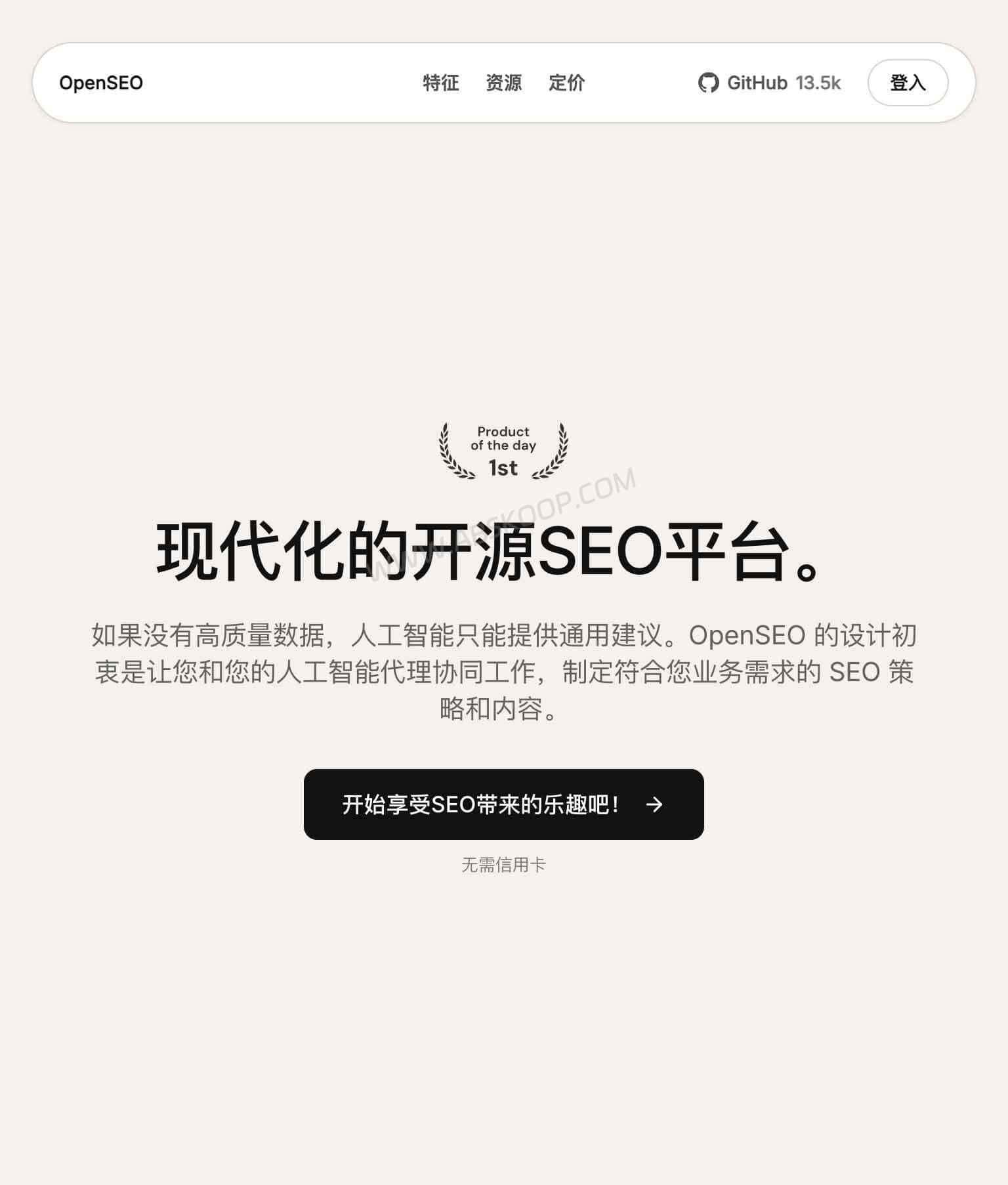
What Is OpenSEO?
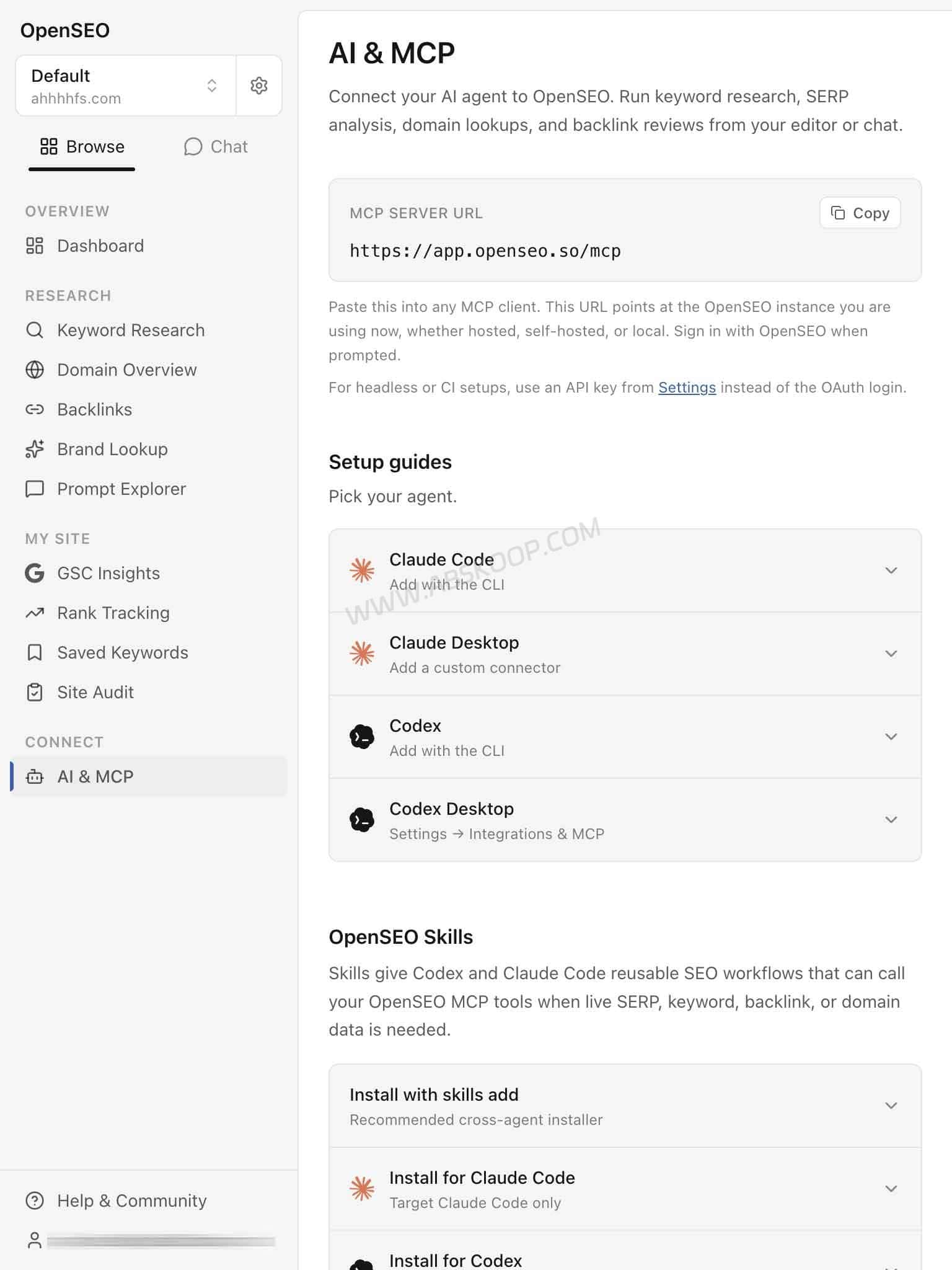
OpenSEO is an MIT-licensed, self-hosted SEO workspace for keyword research, rank tracking, backlink analysis, site audits, and AI visibility monitoring. It also supports MCP integrations with AI coding and Agent tools such as Claude Code and Cursor.
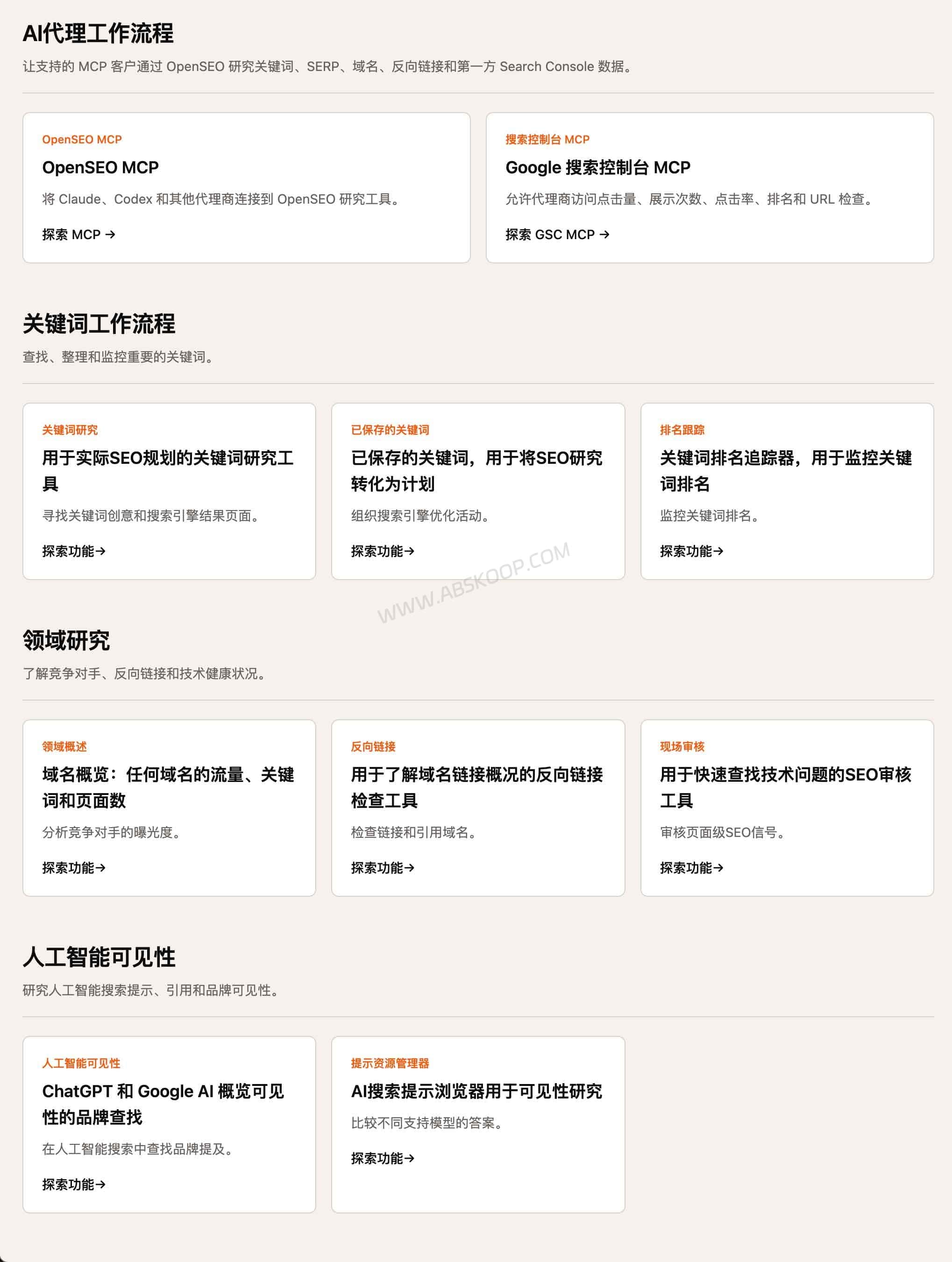
Beyond conventional SEO features, OpenSEO also provides Agent Skills that can bring workflows such as keyword research, SEO audits, and competitor analysis directly into AI Agent environments. You can run OpenSEO on your own infrastructure or use the official hosted version.
The official OpenSEO demo below shows how keyword research, competitor analysis, backlinks, rank tracking, technical audits, and AI search visibility work inside the same workspace.
Where Does OpenSEO Get Its SEO Data?
OpenSEO does not maintain a massive proprietary search and backlink index like Ahrefs. Its core keyword, SERP, ranking, and backlink data primarily comes from the DataForSEO API.
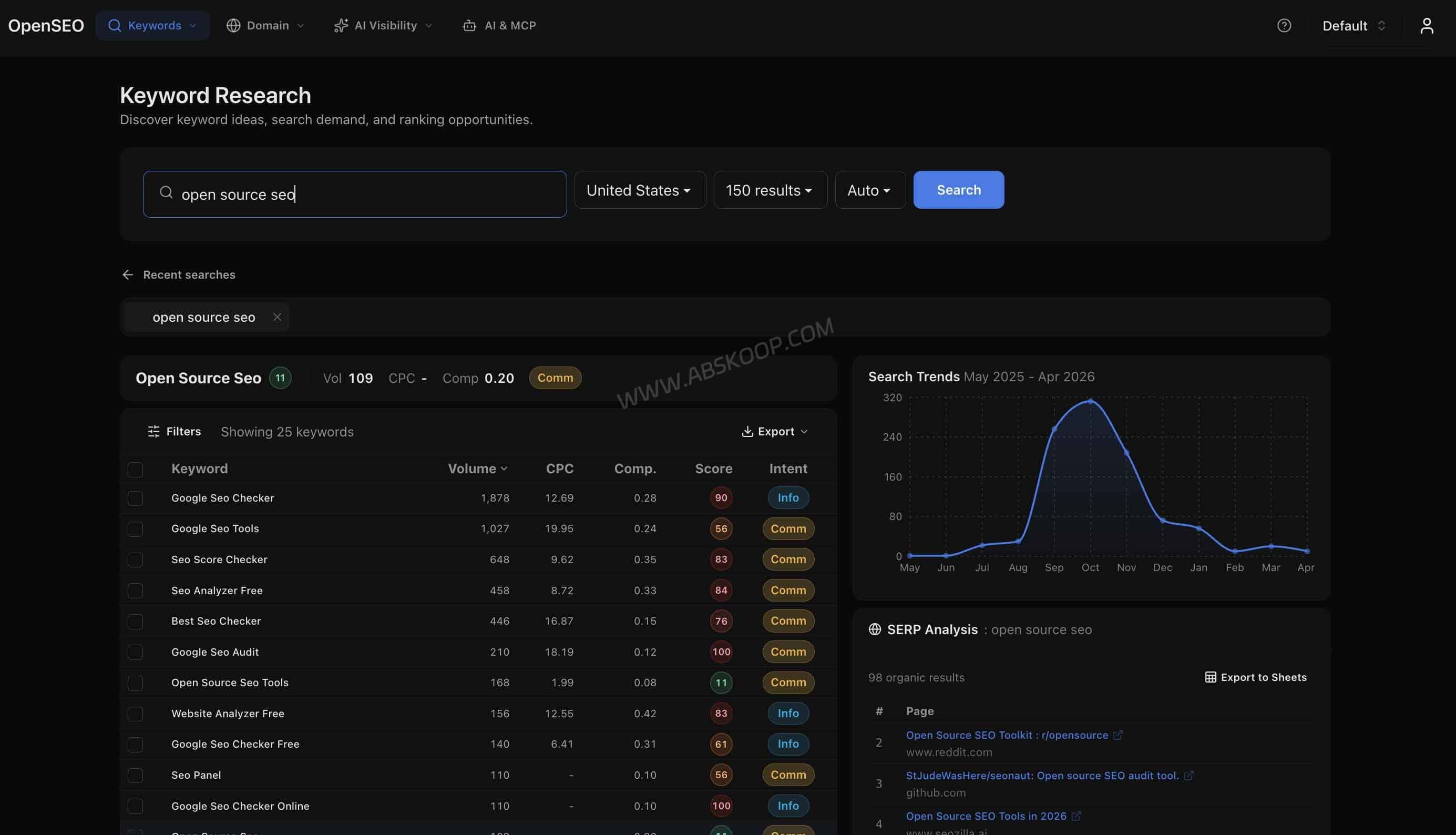
This distinction is important when evaluating OpenSEO’s pricing model: open source software does not mean free SEO data. Even when you self-host OpenSEO, DataForSEO API requests still generate usage charges. What you avoid is paying a fixed subscription fee for the OpenSEO software itself.
According to the current OpenSEO pricing estimator, a keyword lookup is roughly $0.05 per request, while a Domain Overview with one year of historical data is around $0.08. AI visibility checks are more expensive—for example, a ChatGPT brand check is estimated at around $1.09. Actual costs vary depending on query type and usage, so the official pricing calculator should be treated as the current reference.
Ahrefs currently offers a $29/month Starter plan, while the more complete Lite plan starts at $129/month. MCP and API access for Agent workflows requires the Lite tier or above. For users who only run occasional SEO queries, OpenSEO’s usage-based model may offer more control over costs. Heavy daily usage, however, does not automatically make OpenSEO cheaper.
OpenSEO Open Source SEO Tool vs Ahrefs and Semrush
On the surface, OpenSEO covers many familiar SEO tasks, including keyword research, SERP tracking, competitor analysis, and site auditing. What makes it different is not one individual feature, but the combination of self-hosting, usage-based pricing, and MCP / Agent integrations in the same platform.
| Comparison | OpenSEO | Ahrefs / Semrush |
|---|---|---|
| Software model | Open source and self-hostable | Commercial SaaS |
| SEO data | Primarily retrieved through external APIs such as DataForSEO | Built around long-established proprietary data and product ecosystems |
| Pricing model | Free to self-host; SEO data billed by API usage; hosted plan also available | Primarily subscription based |
| MCP / Agent access | Supports MCP and Agent workflows | Ahrefs and Semrush both provide MCP / AI integration options |
| Self-hosting | Docker and Cloudflare deployment options | Full product self-hosting is not available |
| Setup effort | Requires API configuration, deployment, and access controls | Ready to use after signup with minimal maintenance |
| Best suited for | Light usage, self-hosting, and Agent automation workflows | High-volume SEO teams and workflows that depend heavily on historical data |
Can OpenSEO Fully Replace Ahrefs or Semrush?
For now, it is more accurate to think of OpenSEO as a replacement for selected SEO workflows. Keyword research, rank tracking, backlink checks, and Agent automation can all be handled through OpenSEO, but Ahrefs and Semrush still have clear advantages when you need deeper historical data, advanced competitive research, or mature team collaboration features.
MCP is also no longer exclusive to OpenSEO. Both Ahrefs and Semrush now provide MCP integrations that allow tools such as Claude Code and Cursor to access SEO data, although usage remains tied to their respective subscription tiers and API allowances. Ahrefs MCP is available from the Lite plan, while Semrush MCP requests consume the API units included with eligible plans.
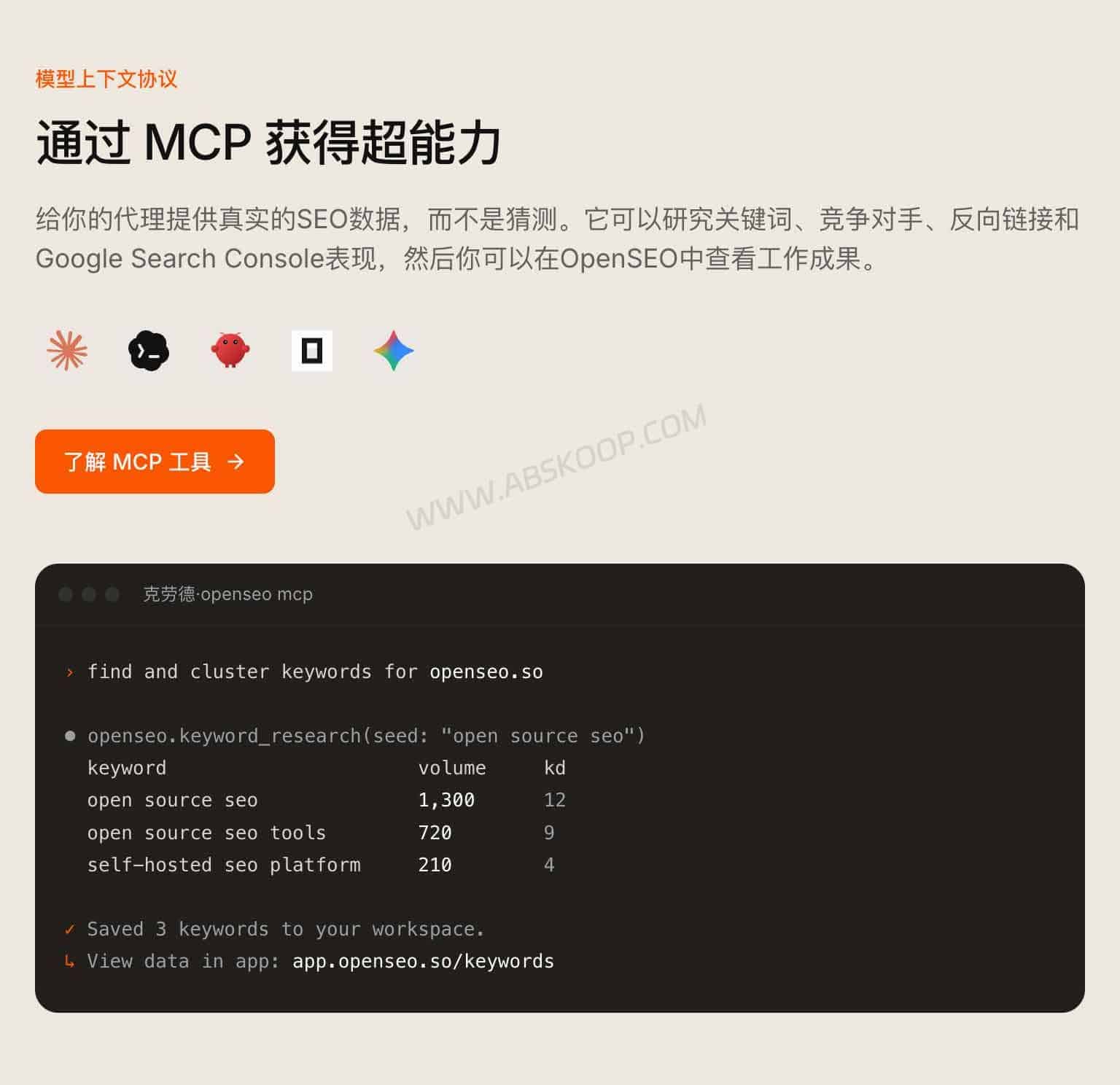
The main difference is how OpenSEO combines self-hosting, DataForSEO usage-based billing, and MCP / Agent integrations inside one platform. For website owners with relatively light query volume who want Claude Code or Cursor to access keyword, ranking, and backlink data directly, this model can be more flexible. At high query volumes, or when deep historical datasets are essential, OpenSEO should not automatically be assumed to be cheaper or more capable.
OpenSEO also ships with a collection of Agent Skills rather than exposing only a raw data interface. The official Skills cover tasks such as keyword research, keyword clustering, SEO audits, competitor analysis, link prospecting, and local SEO.
These Skills can be installed in compatible Agent environments with npx skills add every-app/open-seo. A simple way to think about the difference is that MCP gives an Agent access to SEO data, while a Skill provides a reusable workflow for performing a specific SEO task. This makes OpenSEO more than a thin interface on top of the DataForSEO API.
OpenSEO Self-Hosting Options and Real Costs
If you do not want to maintain your own infrastructure, OpenSEO currently offers a hosted Base Plan for $10 per month, including $10 in usage credits. Google Search Console data does not consume those credits, while features that rely on DataForSEO—such as keyword research, backlinks, competitor analysis, and site auditing—are billed based on usage.
The default example in OpenSEO’s pricing calculator includes 100 keyword searches, 20 Domain Overview requests, and weekly rank tracking for 50 keywords. The estimated usage is roughly $7.12, which fits within the included $10 monthly allowance. This is only an example; actual costs depend on the type and frequency of your queries.
When self-hosting, you use your own DataForSEO account instead of paying OpenSEO’s hosting fee. OpenSEO states that its hosted service adds roughly 28% on top of underlying DataForSEO request costs. New DataForSEO accounts currently receive $1 in trial credits, followed by a minimum top-up of $50. The account balance does not reset each month.
If you want to self-host OpenSEO, there are two main deployment options:
1. Docker deployment: suitable for a local machine or your own server. The application can be started with docker compose up -d.
2. Cloudflare deployment: better suited to public access, multiple devices, or team use. The deployment uses Workers, D1, KV, R2, and Cloudflare Access. OpenSEO says this setup can run within Cloudflare’s free plan, although enabling R2 for the first time requires a valid payment method on the Cloudflare account.
Docker Has No Login Authentication by Default
OpenSEO’s documentation states that Docker deployments use AUTH_MODE=local_noauth by default, meaning the application itself does not provide login authentication.
For that reason, exposing the Docker service directly to the public internet is not recommended. If you need remote access, place it behind an authenticated reverse proxy, Cloudflare Access / Tunnel, or a private network such as Tailscale.
How Reliable Is OpenSEO AI Visibility?
OpenSEO also includes AI Visibility and Prompt Explorer for checking whether a brand appears in AI search results such as ChatGPT and Google AI Overviews. The feature is relevant to current GEO workflows, but it is better treated as a directional signal than as a stable, long-term metric.
One currently tracked issue is that some model versions used by Prompt Explorer lag behind the models available through DataForSEO. Responses are also cached for seven days without including the model version in the cache key, which means users may temporarily continue seeing results generated by an older model even after the underlying model changes.
Because this remains an open implementation issue, AI Visibility is more useful for monitoring trends than treating any single check as a definitive long-term benchmark.
Self-hosting also does not mean every request remains on your own infrastructure. OpenSEO can run on your server and lets you control its database and access layer, but keyword, SERP, and backlink requests still go to DataForSEO. Some Agent features may also send prompts to OpenRouter or the relevant model provider.
In other words, self-hosting gives you more control over the OpenSEO application and how it is deployed, but it does not make the entire SEO and AI data pipeline local.
When Does OpenSEO Make More Sense Than Ahrefs or Semrush?
OpenSEO is a better fit for independent website owners who manage a small number of sites, have relatively light SEO query volume, and are comfortable configuring DataForSEO and Docker. It is particularly useful if Claude Code, Cursor, or another Agent is already part of your workflow and you want SEO data available directly inside that environment.
If your team depends on years of historical data, deeper competitive research, granular user permissions, or mature collaboration features, Ahrefs or Semrush will usually require less maintenance and provide a more established workflow.
Frequently Asked Questions
1. Is OpenSEO free?
The software itself is open source, but you still need a DataForSEO API key and must pay for API usage. OpenSEO also offers a hosted plan starting at $10 per month, including $10 in usage credits.
2. What is the relationship between OpenSEO and DataForSEO?
OpenSEO provides the interface, workflow, and analysis layer, while DataForSEO supplies much of the underlying keyword, SERP, ranking, and backlink data through commercial APIs.
3. Can OpenSEO fully replace Ahrefs?
It can replace some Ahrefs workflows and everyday SEO queries, but it does not replicate the depth of Ahrefs’ proprietary data, historical datasets, or mature enterprise features.
4. Do I still have to pay if I self-host OpenSEO?
Yes. Self-hosting removes OpenSEO’s hosting fee, but DataForSEO API requests still generate usage charges.
5. What does OpenSEO MCP do?
MCP allows compatible AI Agents such as Claude Code and Cursor to access keyword, ranking, backlink, and other SEO data directly without repeatedly exporting datasets by hand.
6. Is OpenSEO Docker deployment secure?
Docker deployments have no built-in login authentication by default. For public access, you should add access controls such as Cloudflare Access, an authenticated reverse proxy, or another secure gateway.
OpenSEO Links and Resources
OpenSEO official website:
https://openseo.so/
OpenSEO GitHub:
https://github.com/every-app/open-seo


Comments (0)