



Computable GPU Index (CGI) is not a typical comparison site designed to show you which provider has the cheapest H100. It is a market reference index for high-end GPU cloud pricing, converting public rental rates from different providers into a standardized $/GPU-hour figure.
This makes it easier to see where public rental prices for GPUs such as the H100 SXM, H200 SXM, B200 and B300 currently sit in the market.
Cloud GPU pricing can vary significantly between providers, especially when different billing models and on-demand rates are involved. For NVIDIA H100, CGI currently tracks the H100 SXM configuration, and public on-demand prices can differ noticeably from one provider to another.

How is CGI different from regular GPU price comparison sites?
GPU comparison sites usually keep the provider name, instance configuration and listed price so users can directly compare which provider is currently cheaper.
CGI works differently. It combines eligible public prices from a fixed Provider Panel into a single reference index.
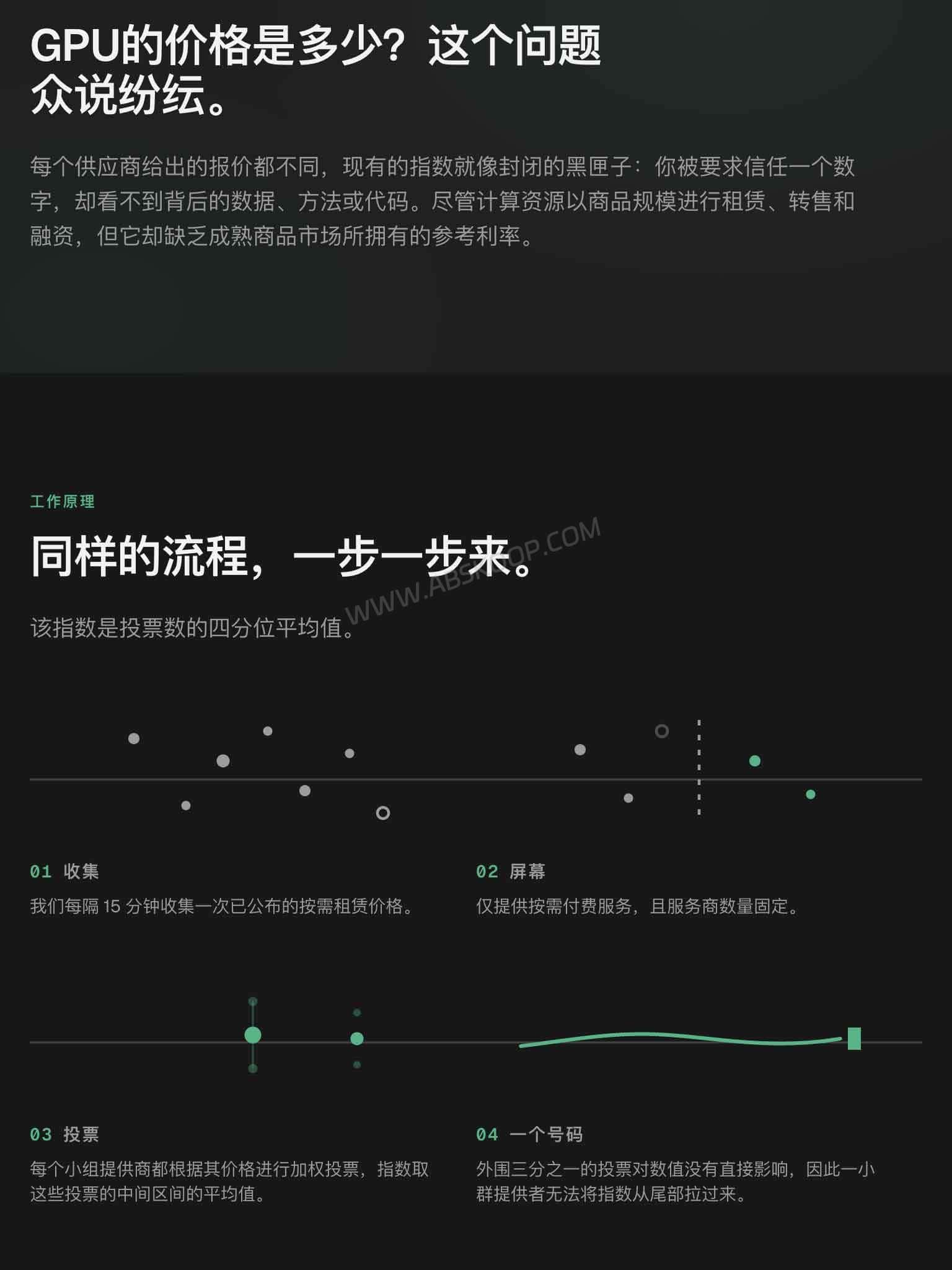
Instance conditions, billing models and additional fees are not identical across GPU providers, so the lowest advertised price is not always the most useful number for long-term budgeting.
CGI uses a fixed provider panel, price screening and weighted aggregation instead of simply averaging every available provider quote.
This makes it more useful for answering a practical question: “What is the current public rental price range for GPUs such as H100 and H200?”
If a provider gives you a quote, you can compare it with the CGI index first and then evaluate the actual billing terms, infrastructure and additional costs.
How much do H100, H200, B200 and B300 cost?
CGI updates every 15 minutes, so these figures only represent the market at a specific point in time.
As of September 4, 2026 at 12:15 UTC, the official live dashboard showed the following index prices:
| GPU | CGI Reference Price |
|---|---|
| NVIDIA H100 SXM | $3.54 / GPU-hour |
| NVIDIA H200 SXM | $4.29 / GPU-hour |
| NVIDIA B200 | $6.65 / GPU-hour |
| NVIDIA B300 | $7.81 / GPU-hour |
For example, the B300 index was around $7.83 per GPU-hour at the time. This gives you a rough idea of where current B300 rental pricing sits.
It is not the final transaction price from any individual cloud provider and does not include Spot pricing, Reserved pricing, storage, networking or private enterprise discounts.
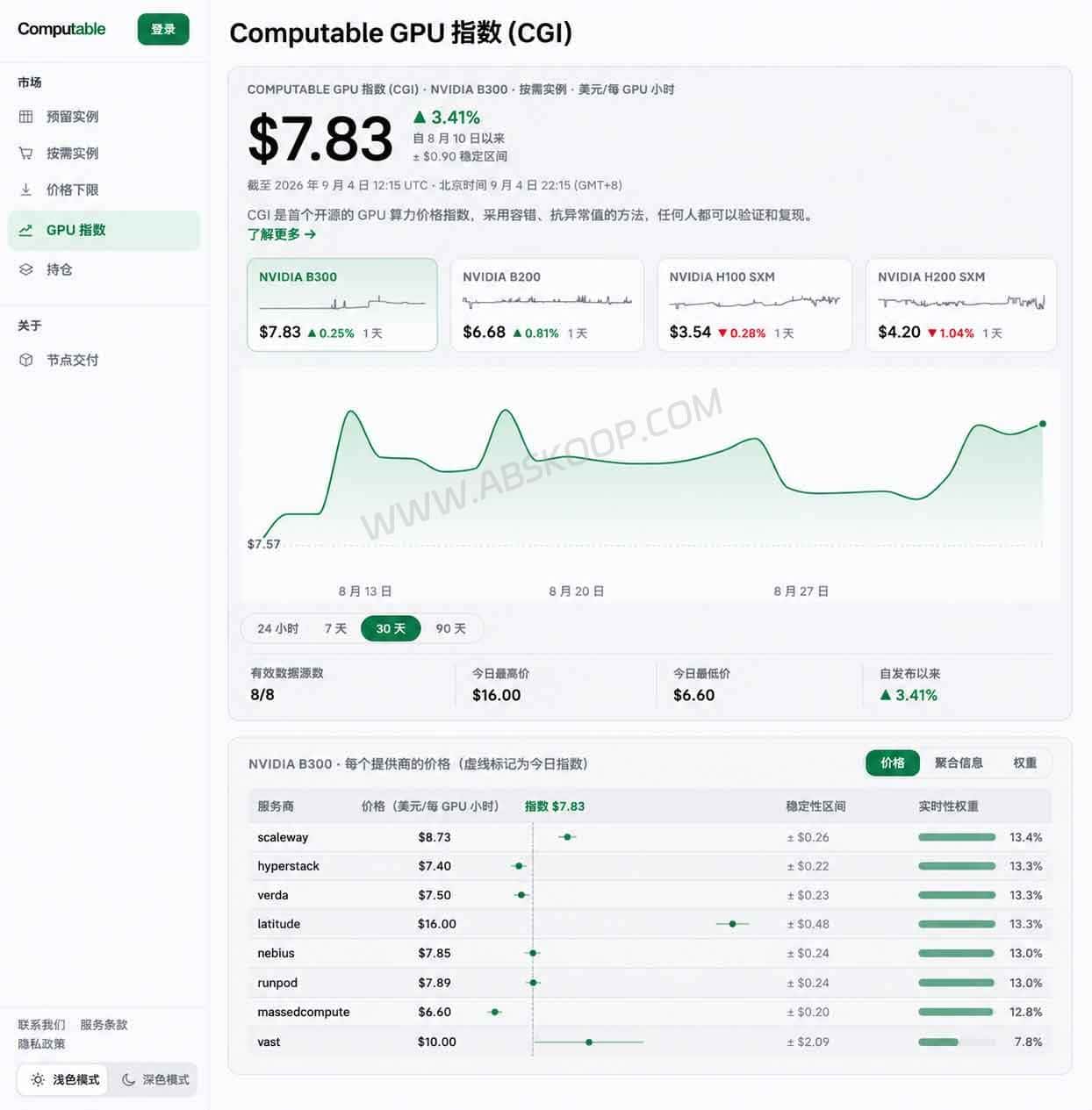
Because prices continue to change, check the CGI live dashboard for the latest numbers.
How does Computable GPU Index calculate GPU cloud pricing?
CGI does not simply add every provider quote together and calculate an average.
It collects public prices, groups them by GPU model and applies screening and weighting rules designed to reduce the influence of extreme prices and less useful observations.
1. Collect public pricing: CGI collects public prices every 15 minutes. At the time this article was prepared, the official Methodology documented 29 providers across 31 collector sources. The total collection coverage is broader than the number of providers that ultimately contribute to an index.
2. Calculate each GPU separately: H100 SXM, H200 SXM, B200 and B300 each have their own fixed Provider Panel. Prices from different GPU models and every collected provider are not mixed together.
3. Provider weights can change: CGI evaluates how provider price movements behave over time, including whether a source tends to move ahead of or lag behind the rest of the panel. This behavior influences its weight in the index.
4. It is not a simple average: CGI uses an interquantile mean (IQM) over price votes, focusing on the central portion of the vote distribution to reduce the influence of unusually high or low prices.
How different are B300 prices between providers?
Using the B300 index from September 4, 2026 at 12:15 UTC as an example, the eight sources that passed the filters showed significant differences in public pricing.
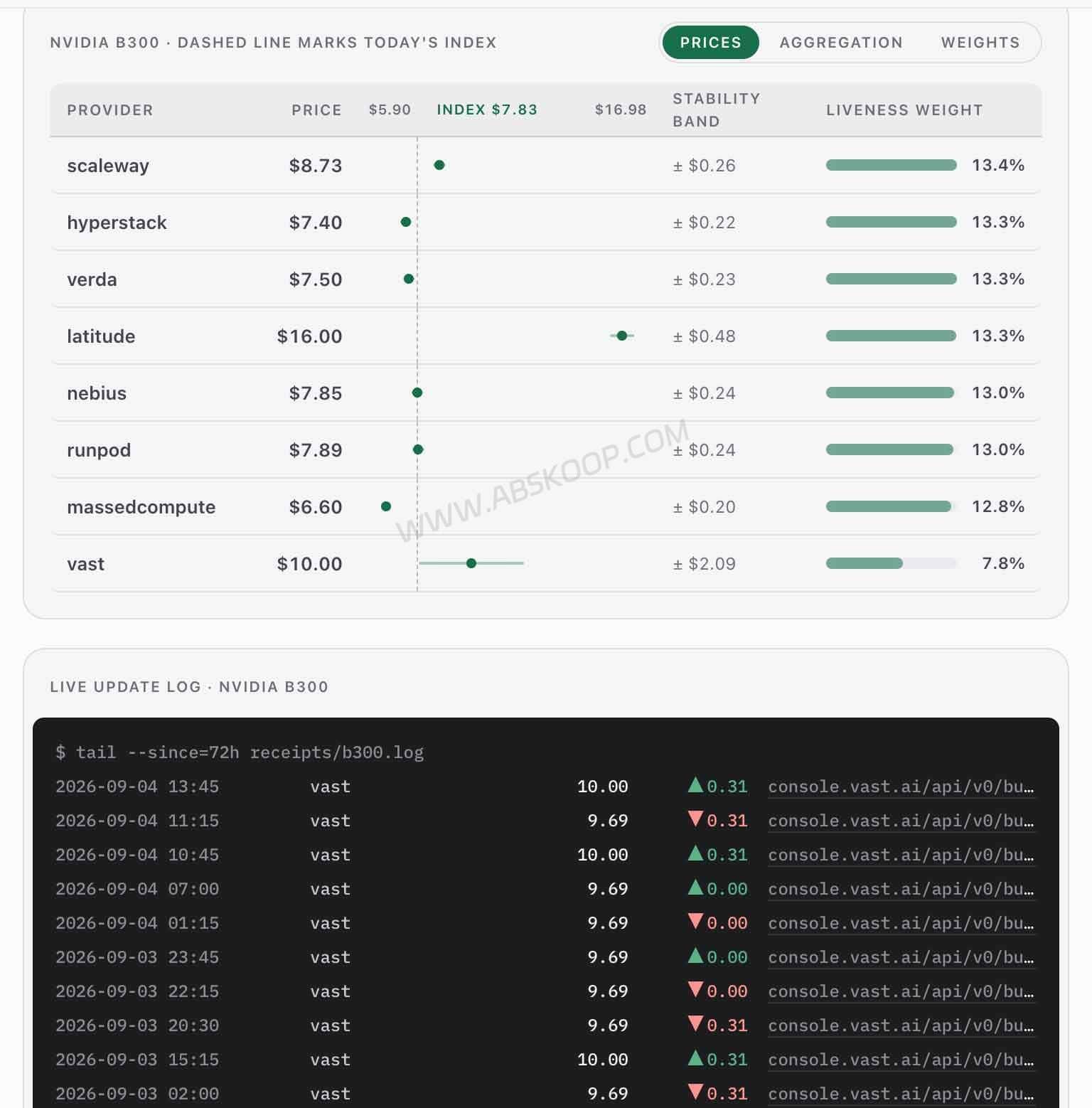
The B300 CGI index at the same time was $7.81 / GPU-hour.
Latitude’s $16 rate was much higher than most of the other providers, but CGI does not simply add all these quotes together and divide by the number of providers. It also does not use the lowest $6.60 quote as the index.
The final reference price is produced using CGI’s screening, weighting and IQM rules.
How can you reproduce the CGI index locally?
The calculation code and historical records are available on GitHub, together with a reproduce script.
After cloning the repository and installing the dependencies, you can reproduce the current day’s H100 index with:
./reproduce h100 "$(date -u +%F)"You can also specify a GPU and date. For example, to reproduce B300 data for September 4, 2026:
./reproduce b300 2026-09-04The script recalculates published index values from the public historical record and checks the resulting values and corresponding hashes.
If everything matches, the locally reproduced results are consistent with the public record published by CGI.
How can developers and AI agents access CGI?
CGI provides more than a web dashboard. Developers can also access the index through a REST API, historical data files and an MCP Server.
These interfaces are currently read-only and do not require account registration or an API key.
REST API: query the latest GPU prices
To query the latest H100 index:
curl "https://api.getcomputable.com/v1/index/H100/latest"To include the source receipts associated with the observation:
curl "https://api.getcomputable.com/v1/index/H100/latest?include=receipts"Historical pricing can also be queried through the history endpoint:
curl "https://api.getcomputable.com/v1/index/H100/history?limit=4"This can be useful for feeding GPU pricing into internal cost dashboards, monitoring scripts or other automation tools without manually opening the website.
How can you download historical CGI pricing data?
CGI also publishes historical records as JSON files at data.getcomputable.com.
These archives can be used for offline analysis, storing historical GPU prices or reproducing previously published index values.
How can an AI agent query GPU prices through MCP?
CGI provides a read-only MCP Server at:
https://mcp.getcomputable.com/mcpThe official MCP Server currently exposes three read-only tools and does not require a separate CGI account or API key.
Once the endpoint is added to an MCP-compatible client, an AI agent can query CGI pricing data directly.
For example, while discussing model training costs, an agent could retrieve the current H100 or B200 index instead of relying only on pricing information already stored in the model’s training data.
What are the limitations of using CGI for GPU cloud pricing?
CGI reflects reference prices from the public on-demand GPU rental market. When comparing the index with an actual cloud provider quote, keep the following limitations in mind.
1. Only four GPUs currently have live indexes: CGI currently publishes live indexes for NVIDIA H100 SXM, H200 SXM, B200 and B300. The collection layer records additional hardware models, but RTX 4090, A100 and L40S do not currently have their own live CGI indexes.
2. The index only uses eligible public on-demand pricing: Spot, Preemptible, Reserved, Committed, Monthly-commit and Serverless prices do not enter the current index. CGI therefore should not be directly compared with spot instances, monthly packages or long-term commitment pricing.
3. GPU hourly pricing is not your final infrastructure cost: CGI measures GPU rental pricing itself. Real-world deployments may also include network egress, storage, cross-region transfer and other additional costs.
4. Open-source code does not mean the pricing data can automatically be used commercially: The project code uses the Apache-2.0 license, while CGI index data and historical archives use CC BY-NC 4.0. Commercial use is restricted by default. If you plan to use the index in a paid product, settlement system or financial product, check the project’s licensing requirements separately.
5. The project is still relatively new: Computable GPU Index has published its source code, methodology and historical records, but its data coverage, community adoption and long-term maintenance still need more time to evaluate.
Computable GPU Index FAQ
Are CGI data and APIs currently free?
Yes. The live dashboard, REST API and MCP Server currently support free, read-only access without account registration or an API key.
Can CGI GPU pricing data be used commercially?
The project code uses Apache-2.0, but the published index data and historical archives use CC BY-NC 4.0, which restricts commercial use by default.
If you plan to use the data in a paid product, settlement system or financial product, review the project’s licensing terms and confirm whether additional permission is required.
Why doesn’t CGI have price indexes for RTX 4090, A100 or L40S?
The underlying collectors record a wider range of GPU hardware, but the currently published live indexes only cover NVIDIA H100 SXM, H200 SXM, B200 and B300.
RTX 4090, A100 and L40S do not currently have their own live CGI indexes.
Does the CGI MCP Server require an API key?
No. The official MCP Server is currently a public, read-only service and does not require account registration or an API key.
Add the official endpoint using the MCP configuration supported by your client.
Are CGI GPU prices actual transaction prices?
No. CGI is a market reference index calculated from public on-demand prices across a fixed provider panel.
It does not represent the final transaction price from any individual cloud provider and does not include Spot pricing, Reserved pricing, private contract discounts, storage or networking costs.
Computable GPU Index official links and resources
Computable GPU Index live dashboard:
https://market.getcomputable.com/gpu-index
Computable GPU Index official website:
https://www.getcomputable.com/
Computable GPU Index GitHub repository:
https://github.com/getcomputable/gpu-index
API and MCP documentation:
https://docs.getcomputable.com/
Computable also operates other GPU compute products and market services. This article covers the Computable GPU Index specifically, not its GPU compute trading services.


Comments (0)